
Where Is Gold Stored in the US? A Look Inside America's Gold Reserve
Key Takeaways:
- America's gold reserve totals just over 261.5 million troy ounces, spread across five federal locations, not one vault.
- Fort Knox holds the largest share of the US gold reserves at 147,341,858 troy ounces, about 59% of the total.
- The West Point Mint and Denver Mint together hold nearly 98 million troy ounces of deep-storage gold.
- The Federal Reserve Bank of New York stores gold for foreign governments and institutions too, not only the US Treasury.
- First National Bullion helps investors hold physical gold of their own, outside the federal reserve system, through secure third-party storage.
Fort Knox holds under 60% of America's gold reserve. The rest sits in four other federal locations most Americans have never heard of.
Treasury Secretary Scott Bessent addressed the topic on Fox News in July 2026, saying the gold is "present and accounted for" and calling it the largest gold pile in the world. His comment reopened a question a lot of people ask: where is gold stored in the US, exactly, and how much is really there?
How Much Gold Does America's Gold Reserve Hold?
The U.S. Treasury's Bureau of the Fiscal Service tracks the total to the fraction of an ounce: just over 261.5 million fine troy ounces, or roughly 8,133 metric tons, as of the most recent published snapshot.
That figure has barely moved since 1974, with no documented gold withdrawals from Fort Knox since then aside from small samples pulled for purity testing.
Federal law still values the gold at $42.2222 per troy ounce, a rate set in 1973. At that statutory rate, the reserve carries a book value near $11 billion; Bessent put its current market worth above $1 trillion.
Source: U.S. Treasury, Bureau of the Fiscal Service
Where Is Gold Stored in the US?
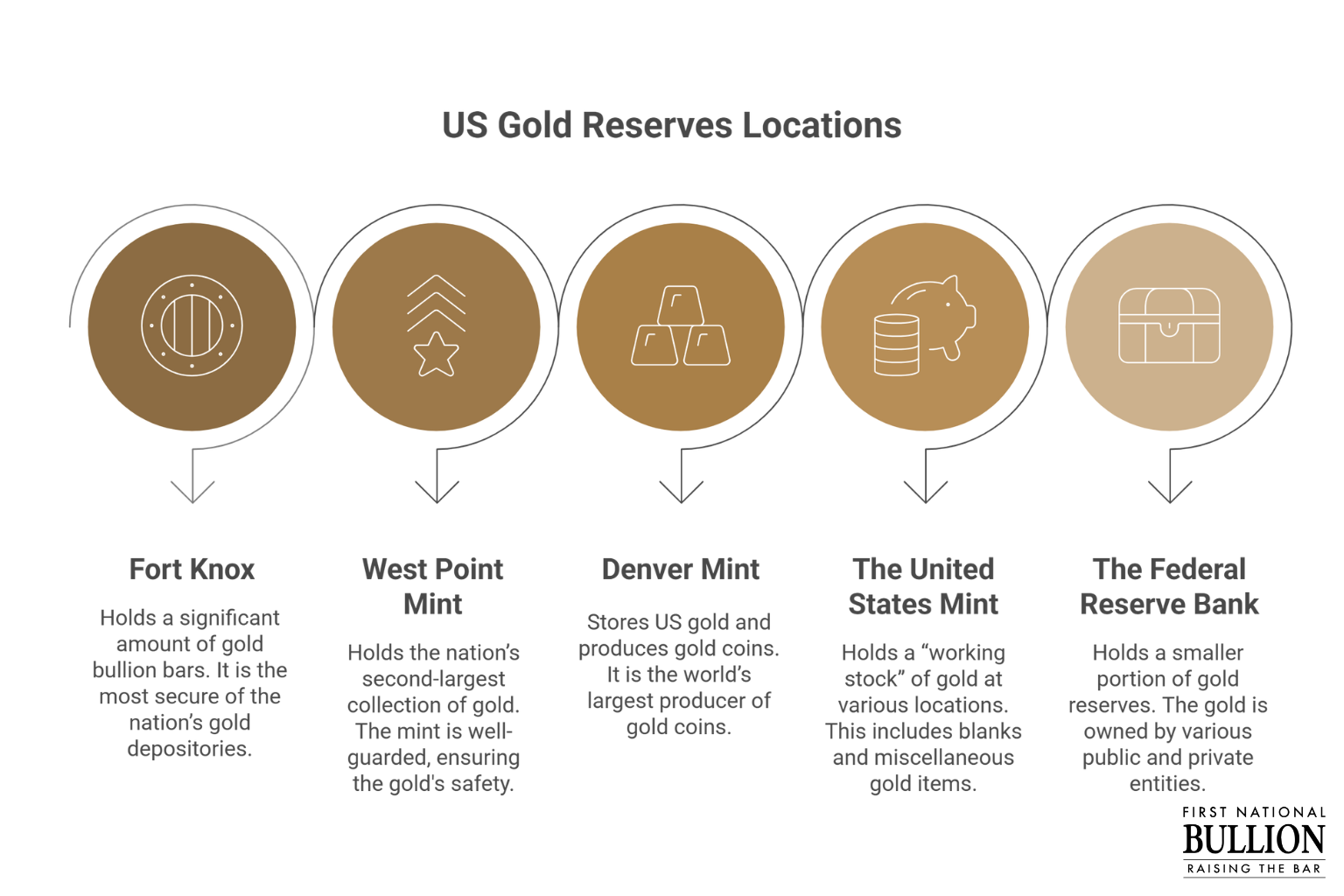
Treasury data splits the total across five places: Fort Knox, the West Point Mint, the Denver Mint, the Federal Reserve Bank of New York, and smaller "working stock" held at Mint facilities nationwide.
Fort Knox, Kentucky
Built in 1936, the United States Bullion Depository holds 147,341,858.382 fine troy ounces of gold bullion, by far the largest share of the US gold reserves. Its walls are lined with granite, and every bar meets a minimum fineness of .9995.
No gold has left the depository since 1974, aside from small testing samples, well below its wartime peak of 649.6 million troy ounces in 1941.
West Point Mint, New York
West Point holds the nation's second-largest gold stockpile: 54,067,331.379 troy ounces in deep storage, once the country's largest silver stockpile before the facility's focus shifted to gold.
Denver Mint, Colorado
The Denver Mint holds 43,853,707.279 troy ounces of deep-storage gold, the third-largest total among Treasury vaults. Opened in 1863 to process Colorado's mining boom, it's now the world's largest producer of gold coins by volume.
Federal Reserve Bank of New York
The New York Fed holds roughly 13.5 million troy ounces in vaults built below sea level. Most of it doesn't belong to the US government; foreign central banks and institutions store gold there too, so this figure isn't solely part of America's gold reserve.
US Mint Working Stock
Beyond deep storage, the Mint keeps 2,783,218.656 troy ounces as "working stock": coins, blanks, and raw material staged for future coin production.
|
Location |
Fine Troy Ounces |
Share of Total |
|
Fort Knox, KY |
147,341,858.382 |
~59% |
|
West Point, NY |
54,067,331.379 |
~21% |
|
Denver, CO |
43,853,707.279 |
~17% |
|
Federal Reserve Bank of NY |
~13,500,000 |
~5%* |
|
US Mint working stock |
2,783,218.656 |
~1% |
*Includes gold owned by foreign governments and institutions, not only the US Treasury.
Source: U.S. Treasury, Bureau of the Fiscal Service
Why Doesn't the US Keep All Its Gold in One Vault?
The answer to where gold is stored in the US comes down to risk and purpose. Splitting the US gold reserves across five sites limits the damage any single fire or breach could cause.
Denver and West Point produce coins and need working gold on hand, while Fort Knox was built purely for deep storage, away from coastal cities considered more exposed to foreign attack when it opened in 1936.
Is America's Gold Reserve Actually Audited?
Yes, though the scope draws debate. The Treasury Inspector General completed its latest audit of the Mint's deep-storage gold and silver schedules on December 12, 2025, and gave the figures a clean opinion.
Bessent's July 2026 remarks confirmed the total, though they weren't based on a personal inspection; he said his staff and the U.S. Treasurer had reviewed the vault in his place.
Some lawmakers want more than an internal audit. Rep. Thomas Massie introduced the Gold Reserve Transparency Act (H.R. 3795) in June 2025 to require an independent physical audit of America's gold reserve every five years.
The bill has stayed with the House Committee on Financial Services since, without a floor vote.
Sources: Treasury Office of Inspector General; Congress.gov, H.R. 3795
Hold Your Own Gold Reserve with First National Bullion
The US gold reserves belong to the federal government, not individual investors, so that they won't protect your own savings during a downturn. First National Bullion has helped investors buy physical gold since 2006 for that reason.
Every order ships insured with a required signature on delivery, and orders of $199 or more ship free.
Investors who'd rather not store bullion at home can arrange secure, third-party storage through an insured depository instead.
First National Bullion also helps customers add physical gold to a self-directed IRA, with the same U.S. Mint-verified coins and bars the Treasury relies on for its own reserves.
Find a store near you in Arizona or California, or shop the full selection online.
This article is for educational purposes and isn't financial advice. Talk with a qualified advisor before making investment decisions.
The statements made in this blog are opinions, and past performance is not indicative of future returns. Precious metals, like all investments, carry risk. Precious metals and coins may appreciate, depreciate, or stay the same in cash value depending on a variety of factors. First National Bullion does not guarantee, and its website and employees make no representation, that any metals for sale will appreciate sufficiently to earn the customers a profit. The decision to buy, sell, or borrow precious metals and which precious metals to purchase, borrow, or sell are made at the customer's sole discretion.
Frequently Asked Questions
Where is gold stored in the US besides Fort Knox?
The West Point Mint, the Denver Mint, and the Federal Reserve Bank of New York each hold a share. Smaller working stock sits at Mint facilities used for coin production.
How much of the US gold reserves does Fort Knox actually hold?
Fort Knox holds about 59% of the total, or 147,341,858.382 troy ounces. The rest is split among West Point, Denver, the New York Fed, and Mint working stock.
Has anyone verified that America's gold reserve is still there?
The Treasury Inspector General audits the Mint's deep-storage gold annually and issued a clean opinion in December 2025. A separate bill calling for an independent physical audit hasn't advanced in Congress as of mid-2026.
Can I buy the same gold the US Treasury holds?
You can buy gold that meets the same purity standards the Treasury requires for deep storage. First National Bullion sells U.S. Mint-issued coins and bars verified to those same fineness benchmarks.